Dialetheia -now there’s a word I haven’t heard before. It means a statement that is both true and false at the same time: a true statement whose negation is also true. I like things like that. It’s of the sort that used to intrigue us many a night in the university dorms of my youth -like the Epimenides paradox. Epimenides was a philosopher from Knossos in ancient Crete, and his paradox was the sentence that all Cretans were liars. For some reason nobody called it a dialetheia though -perhaps because it was never clear whether the word was singular or plural, let alone how to pronounce it without sounding pompously erudite and being asked to spell it…
In the particular case that introduced me to the new word, the consideration in question was ‘What is Art?’[i] I mean, perhaps it is a simple question: Art is something resulting from the expression of human imagination, or creative skill; given the various media which may be involved, not a great definition perhaps, and yet diffuse enough to suggest that Art can include many things. And, much like beauty, and as something I discussed in a previous essay, it may not be judged as such universally. [ii]
So… can the same object be Art, and non-Art? If it is a painting, or a sculpture -or anything, for that matter- surely the producer can be asked about why and perhaps how it was produced; if they -the artist- insists it is Art, and does not deserve a ‘why’ question, then it is Art. Period. While it may not be good Art (whatever that is), and may not convince anybody else that it is particularly compelling or creative, we should probably take the artist at their word… and then maybe not go to whichever gallery is bold enough to display it.
But should the fact that it doesn’t enjoy popularity, or even approval, make it non-Art? Who’s to judge? Opinions differ, public tastes change: today’s garbage may be tomorrow’s delight. I mean, who would have thought that Andy Warhol’s paintings of Campbell Soup cans would be considered Art…?
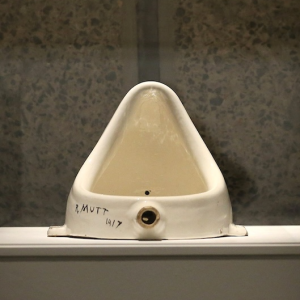
For that matter, who would have thought that Marcel Duchamp’s ‘Fountain’ was Art, and not merely a urinal? He did not create it, or design it; it was visibly indistinguishable from other urinals that came off the same production line. It seems more like a random object chosen with poor taste… he merely signed a urinal. But having done so, his urinal became no longer primarily a useful object – rather, it became a meaningful object. And it could therefore be seen in a new context: if it is Art, then it is art with a higher conceptual than aesthetic value; it is declaring something, rather than unveiling something new and unique… It is about something more than just the thing itself.
As one commentary on the piece put it: ‘It is because the urinal is not art that it has its particular artistic message; and it is only because it is art that it has a message at all. Of course, it can carry other messages as well, for example, that contemporary ideas of art are misguided, that craft is not essential to art, that beauty in art is optional. But it can carry such messages only because, in the artworld of its time, it was not art.’ So it is, and is not, Art.
But wait a minute. I am by no means alone in wondering how an unimpressive, off-the-shelf, and otherwise anonymous urinal suddenly qualifies as Art. The art critic Roberta Smith, similarly puzzled, opined that: ‘[Duchamp] reduced the creative act to a stunningly rudimentary level: to the single, intellectual, largely random decision to name this or that object or activity “art”.’
Maybe the whole thing requires me to surrender the idea of Art as, well, in some normative sense beautiful, and in good taste; depictive… Maybe I have to change Magisteria and dwell more on what sort of thoughts it inspires… Actually on second consideration, that doesn’t really help -it’s still an empty urinal for goodness sakes; if Duchamp had even possessed the creative politesse to thread a rose, or something in one of the drainage holes, I’d rest more easily.
Still, maybe that is just ‘Old School’; I suspect that most of us still regard Art as having ‘more value than simple craft: some intimation, through beauty, of spiritual or philosophical truths.’ As the sociologist Pierre Bourdieu once wrote of those times, ‘the artist worked with or against matter to afford some moral, metaphysical or at least aesthetic vision, which was ‘higher’ than ordinary commerce and labour’.
‘Duchamp’s Fountain was the antithesis of this. There was no obvious craft – and certainly no fine artistry. The urinal was designed and manufactured to some standard, but one of utility, not aesthetics.’ In other words, as has been suspected by many others, ‘the message of Fountain was one of mockery: of modern ideals of art. It mocked, not by parodying fine art, but by being its stark opposite: uncrafted by the author, ugly, utilitarian, vulgar, ubiquitous…’
And yet, it has accomplished something, I suppose: that we are able to evaluate his urinal for other reasons than its utility, or its aesthetics. And what is that message -one that without its categorization as Art would not even be suspected? Well… that it is not Art, of course! ‘This message is one of so-called ‘anti-art’. What gives the work its power is that it is not art; but that, at the same time, it is art.’
Okay, the dialetheism works like this. ‘The object’s category is ‘art’. And as art, it has a message. In this case, its message is about its own category: it says to the viewer – truly – ‘this is not art’. The dialetheia arises because the message requires the very category it rejects, art; and because this rejection is its message within this category. The rejection of its status as an artwork is the very thing that makes it an artwork, which it rejects…’
I wonder if Duchamp, rather than Epimenides, would be the subject of late night discussions in the college dormitories of today. I’d love to give it a try anyway; It’d be fun to try out the word ‘dialetheia’, now that I know how to spell it…
[i]https://aeon.co/essays/how-can-duchamp-s-fountain-be-both-art-and-not-art?
[ii]https://musingsonwomenshealth.com/2018/12/26/beauty-is-but-a-vain-and-doubtful-good/
- March 2026
- February 2026
- January 2026
- December 2025
- November 2025
- October 2025
- September 2025
- August 2025
- July 2025
- June 2025
- May 2025
- April 2025
- March 2025
- February 2025
- January 2025
- December 2024
- November 2024
- October 2024
- September 2024
- August 2024
- July 2024
- June 2024
- May 2024
- April 2024
- March 2024
- February 2024
- January 2024
- December 2023
- November 2023
- October 2023
- September 2023
- August 2023
- July 2023
- June 2023
- May 2023
- April 2023
- March 2023
- February 2023
- January 2023
- December 2022
- November 2022
- October 2022
- September 2022
- August 2022
- July 2022
- June 2022
- May 2022
- April 2022
- March 2022
- February 2022
- January 2022
- December 2021
- November 2021
- October 2021
- September 2021
- August 2021
- July 2021
- June 2021
- May 2021
- April 2021
- March 2021
- February 2021
- January 2021
- December 2020
- November 2020
- October 2020
- September 2020
- August 2020
- July 2020
- June 2020
- May 2020
- April 2020
- March 2020
- February 2020
- January 2020
- December 2019
- November 2019
- October 2019
- September 2019
- August 2019
- July 2019
- June 2019
- May 2019
- April 2019
- March 2019
- February 2019
- January 2019
- December 2018
- November 2018
- October 2018
- September 2018
- August 2018
- July 2018
- June 2018
- May 2018
- April 2018
- March 2018
- February 2018
- January 2018
- December 2017
- November 2017
- October 2017
- September 2017
- August 2017
- July 2017
- June 2017
- May 2017
- April 2017
- March 2017
- February 2017
- January 2017
- December 2016
- November 2016
- October 2016
- September 2016
- August 2016
- July 2016
- June 2016
- April 2016
- January 2016
- December 2015
- November 2015
- October 2015
- September 2015
- August 2015
- July 2015
- June 2015
- May 2015
- April 2015
- March 2015
- February 2015
- January 2015
- December 2014
- November 2014
- October 2014
- September 2014
- August 2014
- July 2014
- June 2014
- May 2014
- April 2014
- March 2014
- February 2014
- January 2014
- December 2013
- November 2013
- October 2013
- September 2013
- August 2013
- July 2013
- June 2013
- May 2013
- April 2013
- March 2013
- February 2013
- January 2013
- December 2012
- November 2012
- October 2012
- September 2012
- August 2012
- July 2012
- June 2012
 musingsonwomenshealth.com
Leave a comment