Can we really speak from places where we are not; from times we have visited and then been forced to leave; pretend we still understand how it felt to be young? What truth can memories tell us of our lives…?
Do we only remember the sharp edges of things: the significant comings and goings of life, and forget that most of the time, we attended our days like shadows? If I’m honest with myself, I’m not sure anymore. Age can soften edges, dissolve them at times if we’re not careful. My longtime habit of writing essays, rather than chronicling my life in an ever-growing diary, is suspect I suppose, but it’s all I have. What I wrote colours what I remember; words are powerful creatures with lives of their own. Have some of them crayoned themselves outside of the lines provided? At my age, I suppose I’ll never know.
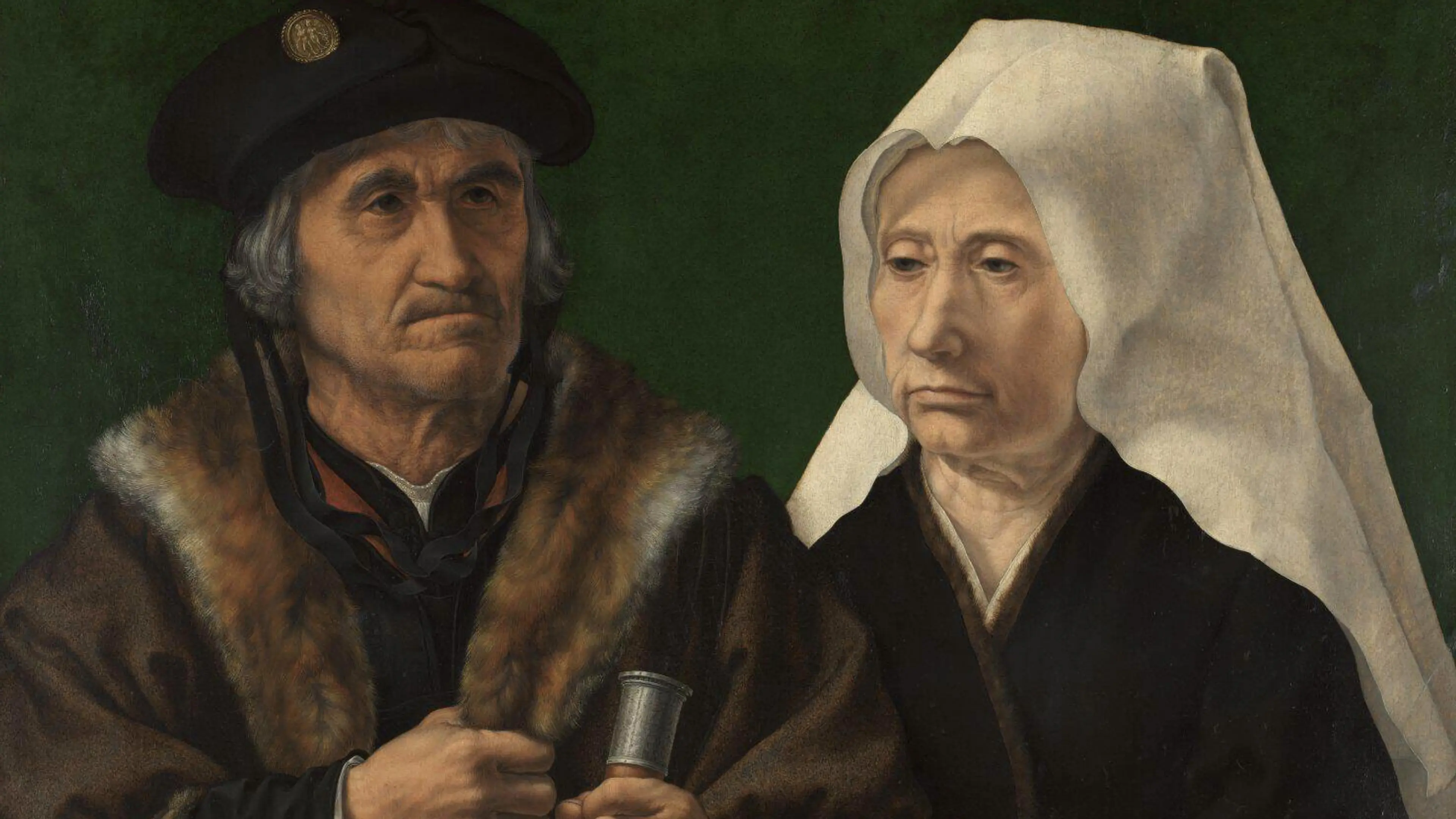
What got me thinking about this was the 1520 painting by Jan Gossaert (An Elderly Couple); I decided it should head my essay. It makes me think of so many of my elderly friends and their enduring love for their partners. To look at the painting however, one might be excused for thinking that the indifference each seems to show for the presence of the other would argue against an enduring love, but I suspect that love, too, requires tolerance to persist; familiarity with the foibles of the other allows inward smiles. Eyes do not always twinkle, faces do not always wrinkle with laughter.
I can’t help but remember some of the words of one of my favourite poets, Kahlil Gibran: Love gives naught but itself and takes naught but from itself. Love possesses not, nor would it be possessed; for love is sufficient unto love. As for my memories of Love, there are another few lines in the same poem that perhaps better describe my experience with it: When love beckons to you, follow him, though his ways are hard and steep. And when his wings enfold you yield to him, though the sword hidden among his pinions may wound you. But, sometimes the injuries are a signal; sometimes even friendships require distance.
Now that the hormones of youth have faded, and passion is just a blurred memory, I find I do not understand the purpose of Love; I do not know why we feel an attraction to others of whichever sex. Companionship? Loneliness? Mutual assistance…? Love is now an enduring mystery to me, although I am not entirely free of its attraction despite my age.
Curious, I found myself attracted to an online article[i] of the same Gossaert painting which I’d chosen for the frontispiece of my own essay. Its allure was intriguing; in some ways it reminds me of the 20ieth century painting American Gothic by Grant Wood, but, as an octogenarian, it could well be that I was simply innocently rabbit-holed.
Still, I fear I have digressed; I meant to focus on Love, and how, at best, it is not only mysterious, but, dare I say, tenuous. The author of the article (John Kaag, the Donohue Professor of Ethics and the Arts and Chair of Philosophy at the University of Massachusetts) introduced me to a poem I had not read by Emily Dickinson: Why do I love You, Sir? Although I find it profound, still, it is confusingly punctuated, so at the risk of foisting my own tastes on you, dear reader, I beg your indulgence and will quote it in full:
“Why do I love” You, Sir?
Because—
The Wind does not require the Grass
To answer—Wherefore when He pass
She cannot keep Her place.
Because He knows—and
Do not You—
And We know not—
Enough for Us
The Wisdom it be so—
The Lightning—never asked an Eye
Wherefore it shut—when He was by—
Because He knows it cannot speak—
And reasons not contained—
—Of Talk—
There be—preferred by Daintier Folk—
The Sunrise—Sire—compelleth Me—
Because He’s Sunrise—and I see—
Therefore—Then—
I love Thee—
The point, I think, is that the mystery of Love is similar to Zeno’s paradox of Achilles never being able to catch the tortoise: words are insufficient to describe something that superficially seems so obvious; so easily understandable, if not accurately describable. Why should such ecstasy be so fragile and, well, so time-limited for some of us?
I have not forgotten my former partner, although we have been apart now for many years. I still feel love for her, although admittedly of a different sort; there is certainly a much weaker bond between us than when we were together… So, is that still Love? Is Friendship love, or something else – perhaps less like the power an adjective has to describe its noun, and more like the bond an adverb has to a verb that has escaped its clutches and walked away?
I doubt that for most of us, falling into or out of love is a rational act unless we have come to see it as serving a purpose for each of us; it is not exactly a transactional agreement whose terms are laid out beforehand and the breech or acceptance of shared items are defined in the contract; it is more like an accident that occurs without a formal signing. Mine was like that, I think, although any expectations or stipulations are now gradually fading like the circuits of my aging memory. And maybe that ambiguity is a good thing to take with me into my twilight years.
I cast my mind back to the Prophet of Gibran’s poem: ‘And think not you can direct the course of love, for love, if it finds you worthy, directs your course. Love has no other desire but to fulfil itself. But if you love and must needs have desires, let these be your desires: To melt and be like a running brook that sings its melody to the night, to know the pain of too much tenderness. To be wounded by your own understanding of love.’
Mine never melted; it just changed to pain with time; perhaps I am still wounded…
[i] https://psyche.co/ideas/theres-no-good-reason-to-love-each-other-and-thats-a-relief
- April 2026
- March 2026
- February 2026
- January 2026
- December 2025
- November 2025
- October 2025
- September 2025
- August 2025
- July 2025
- June 2025
- May 2025
- April 2025
- March 2025
- February 2025
- January 2025
- December 2024
- November 2024
- October 2024
- September 2024
- August 2024
- July 2024
- June 2024
- May 2024
- April 2024
- March 2024
- February 2024
- January 2024
- December 2023
- November 2023
- October 2023
- September 2023
- August 2023
- July 2023
- June 2023
- May 2023
- April 2023
- March 2023
- February 2023
- January 2023
- December 2022
- November 2022
- October 2022
- September 2022
- August 2022
- July 2022
- June 2022
- May 2022
- April 2022
- March 2022
- February 2022
- January 2022
- December 2021
- November 2021
- October 2021
- September 2021
- August 2021
- July 2021
- June 2021
- May 2021
- April 2021
- March 2021
- February 2021
- January 2021
- December 2020
- November 2020
- October 2020
- September 2020
- August 2020
- July 2020
- June 2020
- May 2020
- April 2020
- March 2020
- February 2020
- January 2020
- December 2019
- November 2019
- October 2019
- September 2019
- August 2019
- July 2019
- June 2019
- May 2019
- April 2019
- March 2019
- February 2019
- January 2019
- December 2018
- November 2018
- October 2018
- September 2018
- August 2018
- July 2018
- June 2018
- May 2018
- April 2018
- March 2018
- February 2018
- January 2018
- December 2017
- November 2017
- October 2017
- September 2017
- August 2017
- July 2017
- June 2017
- May 2017
- April 2017
- March 2017
- February 2017
- January 2017
- December 2016
- November 2016
- October 2016
- September 2016
- August 2016
- July 2016
- June 2016
- April 2016
- January 2016
- December 2015
- November 2015
- October 2015
- September 2015
- August 2015
- July 2015
- June 2015
- May 2015
- April 2015
- March 2015
- February 2015
- January 2015
- December 2014
- November 2014
- October 2014
- September 2014
- August 2014
- July 2014
- June 2014
- May 2014
- April 2014
- March 2014
- February 2014
- January 2014
- December 2013
- November 2013
- October 2013
- September 2013
- August 2013
- July 2013
- June 2013
- May 2013
- April 2013
- March 2013
- February 2013
- January 2013
- December 2012
- November 2012
- October 2012
- September 2012
- August 2012
- July 2012
- June 2012
 musingsonwomenshealth.com
Leave a comment